


 Tiếng Việt
When sourcing bulk packaging orders, many businesses face a critical strategic question: Should a company work directly with a PP woven manufacturer or partner with an intermediary trading company? This decision not only impacts the bottom line but also dictates delivery schedules, product quality, and technical customization capabilities.
Below, WEPAC breaks down the key differences between these two models to help brands determine the most optimal solution for their operational needs.
Distinguishing a PP woven manufacturer from a trading company in packaging production
Although both supply PP woven bags to the market, a PP woven manufacturer and a trading company operate under completely different business models. Understanding the core mechanics of each will help enterprise buyers select the right partner aligned with their order volumes and strategic goals.
Capabilities and operational model of a PP woven manufacturer
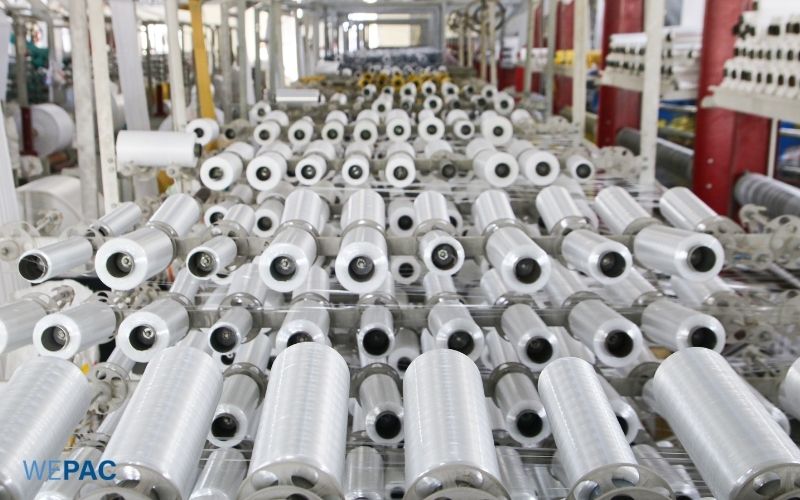
A PP woven manufacturer is a direct production entity that owns and operates the machinery required to transform raw plastic resin into finished bags under one roof.
- Direct raw material sourcing: By purchasing PP resin directly from primary suppliers, manufacturers maintain tight control over resin quality while keeping input material costs stable.
- Vertically integrated production: Operations run seamlessly through a single continuous system, from tape extrusion and weaving to lamination, printing, cut-and-sew, and final packaging.
- Direct technical support: In-house engineering teams work directly with enterprise clients to handle complex OEM/ODM design requirements, ensuring technical specifications are accurately brought to life.
- Consistent quality control: Rigorous internal QC protocols are enforced across every production batch to guarantee uniform product quality.
Comparing a PP woven manufacturer vs. an intermediary trading company
Each partnership model brings distinct value depending on an enterprise’s scale, budget, and operational resources.
| Criteria | PP woven manufacturer | Trading company |
| Pricing and budget | Optimized for large volume orders: Direct factory pricing without middleman markups, but requires high MOQs | Flexible for small orders: Higher unit costs due to trade margins, but accommodates low MOQs |
| Management and communication | Requires client-side resources: Demands technical-savvy personnel to liaise directly with the factory | Time-saving: The intermediary manages end-to-end execution on behalf of the client |
| OEM/ODM customization | Advanced technical handling: Ideal for highly proprietary, custom designs | Limited technical capabilities: Requires multi-layered communication; better suited for standard designs |
| Credentials and certifications | Direct ownership of original factory certifications | Dependent on third-party manufacturing partners. |
Why direct collaboration with a PP woven manufacturer optimizes budgets
For orders that meet minimum order quantities (MOQs) and require custom technical specifications, partnering directly with a PP woven manufacturer delivers superior economic efficiency.
4 core advantages of partnering directly with a PP woven manufacturer
Eliminating unnecessary intermediaries serves as the primary driver for optimizing financial resources, particularly across large-scale campaigns or long-term production schedules:
- Optimized unit cost: Cutting out third-party markups allows enterprise buyers to realize significant budget savings compared to sourcing through commercial trade entities.
- Transparent quality control: Enterprise clients can independently evaluate factory capability, approve physical prototypes on-site, and monitor production progress in real time.
- Agile technical customization: Modifications regarding dimensions, fabric GSM, print color matching, or bag structural elements are executed immediately by in-house engineering and production teams, eliminating communication lag and errors.
- Accelerated turnaround times: Prototype approval and specification sign-offs move significantly faster when working without intermediate communication layers.
When should brands prioritize working with a trading company?
The commercial trading model remains a viable solution for specific supply chain scenarios where flexibility takes precedence:
- Trial orders or volumes below factory MOQ: Trading companies aggregate smaller orders from multiple clients, granting smaller businesses access to packaging inventory without reaching factory-level minimums.
- Multi-category packaging sourcing: When procurement requires multiple packaging types simultaneously, a trading company serves as a single point of management, reducing vendor coordination overhead.
- Limited operations and logistics expertise: Intermediary entities handle end-to-end documentation, shipping arrangements, and supply chain risk management, allowing emerging brands to maintain a lean internal workforce.
Criteria for evaluating a reputable PP woven manufacturer
In supply chain management, selecting a packaging production partner goes beyond comparing price sheets; it requires identifying long-term operational stability.
5 golden standards for choosing the right quality PP woven manufacturer
A reputable PP woven manufacturer proves its capability through structured operations rather than sales pitches:
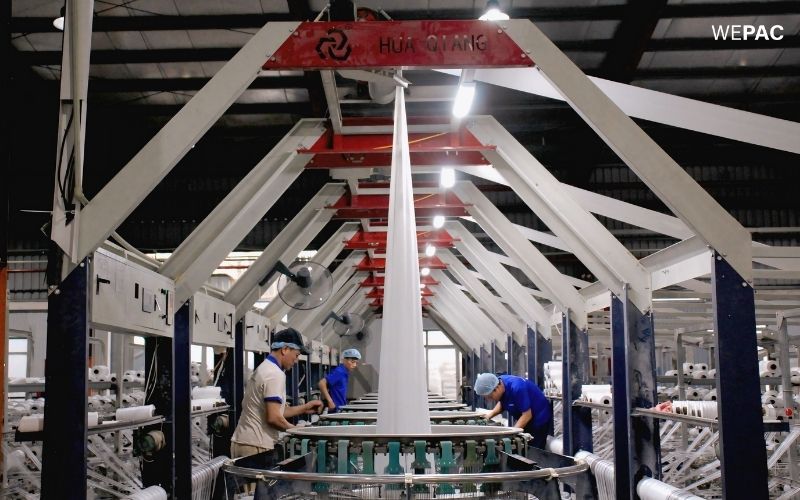
- In-house integrated lines: Full internal execution, from yarn extrusion to final sewing, without outsourcing critical phases.
- International certifications: Recognized accreditations like ISO 9001:2015, BSCI, and GRS for recycled materials.
- Advanced printing infrastructure: High-precision gravure printing up to 8 colors sets large facilities apart from small workshops.
- Rigorous QC protocols: In-line tensile load testing, needle detection, and AQL sampling at every stage.
- Proven export track record: A documented history of serving international markets with smooth customs clearance.
Critical pre-contract checklist for enterprise buyers
To evaluate transparency and operational alignment, enterprise buyers should address several core questions during preliminary discussions with a PP woven manufacturer:
- Is the facility open to on-site audits and factory visits by prospective buyers?
- What is the exact lead time for physical prototyping, and how are revision costs allocated if samples require adjustments?
- What standard procedures and compensation frameworks govern non-conforming or defective items that fail agreed specifications?
- Does the factory have documented experience supplying regulated markets such as the EU, North America, or Japan?
- What are the specific MOQs per bag design, and what flexible payment terms are available for bulk orders?
WEPAC – Export-standard PP woven manufacturer
Established in 2017 in Thai Binh, WEPAC has progressively built its reputation as a leading manufacturer of reusable packaging in general, and high-quality PP woven bags in particular, within Vietnam.
Large-scale production capabilities of a leading PP woven manufacturer
Operating two facilities across 2.8 hectares, WEPAC maintains an output of 12 million bags per month.
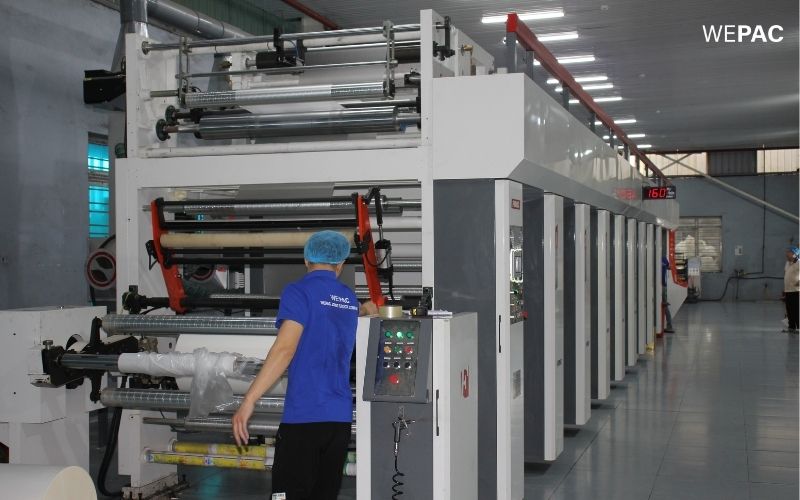
As a fully integrated PP woven manufacturer, WEPAC controls all stages internally, from tape extrusion to 8-color Pantone gravure printing and final sewing. Quality control relies on needle detectors, load testing equipment, and AQL inspections.
The facility holds ISO 9001:2015, BSCI, and GRS accreditations, meeting strict EU, North American, and Japanese import standards.
Why major global partners trust WEPAC
Over nearly a decade of growth, WEPAC has earned its standing as a reliable OEM/ODM packaging partner for world-class brands and multinational retail chains across highly regulated markets:
- Prominent client roster: Proud partner to global industry leaders, including Samsung C&T, Costco, Bunnings Warehouse, Reebok, Daiso, Hobby Lobby, and Harbor Freight.
- Turnkey OEM/ODM solutions: Complete end-to-end support covering material selection, physical sample development per project brief, and export-import customs documentation.
- Flexible MOQ framework: Accepting orders starting at 5,000 bags, enabling seamless rollouts for both trial market runs and massive commercial deployments.
- Extensive global export footprint: WEPAC products are distributed across 30+ countries, supported by flawless international compliance records.
Conclusion
When procuring bulk PP woven bags with custom specs, collaborating directly with an established PP woven manufacturer delivers the most viable economic and operational strategy. Success depends on selecting a certified partner with proven capacity and export experience.
WEPAC provides end-to-end support from concept formulation through volume manufacturing and timely delivery. Contact the WEPAC team today for technical consultation and competitive factory-direct quotes.